
What is a Blockchain Explorer?
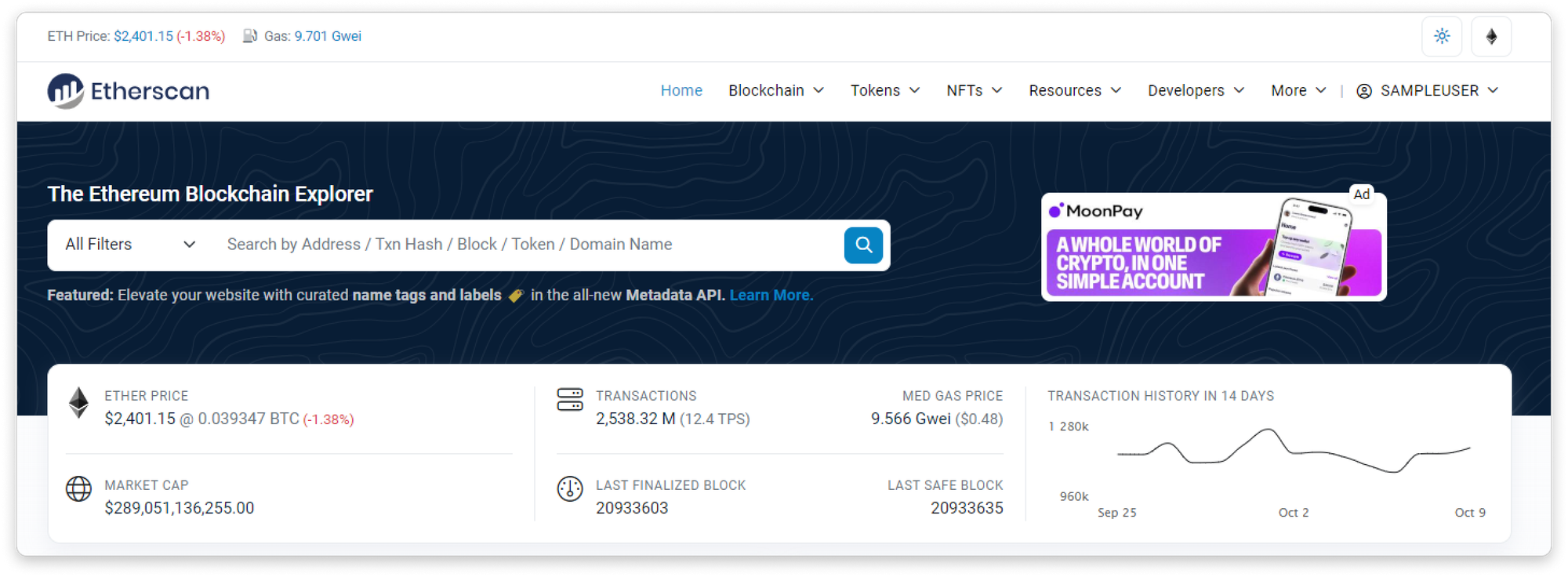
A blockchain explorer, also called a block explorer, is a search engine for a blockchain.
You enter a transaction hash, a wallet address, a block number, or a token or contract address, and it shows what the blockchain recorded: who sent what to whom, when, for how much, and whether it succeeded.
Block explorers are free to use and need no account or wallet.
Blockchains such as Ethereum are public ledgers. Every transaction is stored by thousands of nodes, but in a raw format that is hard for people to read. An explorer indexes that data and turns it into pages you can read, search, and share with a link.
What Can You Do With a Blockchain Explorer?
- Check whether a transaction went through. Paste the transaction hash to see its status (success, failed, or pending), the sender, the recipient, the value, and the fee paid. Learn more in What is a Transaction Hash (Txhash)?
- Look up any wallet address. See its balance, the tokens and NFTs it holds, and every incoming and outgoing transaction. Learn more in What is an Ethereum Address?
- Inspect a block to see when it was produced, which validator proposed it, and which transactions it includes. See Exploring the Block Page.
- Read smart contracts, including verified source code, read and write functions, internal transactions, and event logs. See Verifying Contracts.
- Follow token transfers for ERC-20 tokens and NFTs (ERC-721 and ERC-1155). See Understanding the Token Page.
- Check gas prices before you send a transaction. See What is Gas Fee?
- Review token approvals you have granted to apps and revoke the ones you no longer use, with the Token Approval Checker.
Learn how to navigate the Etherscan homepage.
Which Block Explorer Should I Use?
Use an explorer that indexes the blockchain your transaction is on. An Ethereum explorer can't show a Bitcoin or Solana transaction, because that data lives on a different chain.
- Ethereum: Etherscan
- BNB Smart Chain: BscScan
- Base: BaseScan
- Arbitrum One: Arbiscan
- Polygon PoS: PolygonScan
- Solana: Solscan
- Several chains at once, including Bitcoin and Solana: Blockscan
All of the explorers above are run by Team Etherscan.
What is Etherscan?
Etherscan is the leading block explorer for the Ethereum Blockchain. We are independently operated and developed by a team of individuals who are truly passionate and excited about the kinds of decentralized information and infrastructure applications that Ethereum makes possible.
The Ethereum Blockchain has a public ledger (like a decentralized database) which Etherscan.io indexes and then makes available this information through our site. Our mission is to facilitate Blockchain transparency by indexing and making searchable all transactions on the Ethereum Blockchain in the most transparent and accessible way possible.
Beyond Ethereum, Team Etherscan also powers blockchain explorers for many other blockchain networks, including Base, BNB Chain, Polygon, Arbitrum, Solana, and more, through our Explorer as a Service (EaaS) solution.
Can I Get Block Explorer Data Through an API?
Yes. Most block explorers also offer an API, so developers can pull the same data into their own apps, scripts, and dashboards instead of reading it on a web page.
Developers can use the Etherscan API to query balances, transactions, token transfers, contract source code and ABIs, event logs, and gas prices. One API key works across 50+ supported chains. To start, create a free API key.
Developers and AI agents can also work with data from multiple blockchains through Etherscan’s Build with AI resources. These include the official Etherscan MCP server, the Etherscan CLI, reusable skills, and machine-readable documentation for integrating live onchain data into applications and automated workflows.
Who Uses a Block Explorer?
- Everyday users check that a payment arrived, look up a wallet's balance, and confirm a transaction before contacting support.
- Traders and researchers follow large transfers, study token holders, and track how funds move between addresses.
- Developers read contract code, debug failed transactions, and query the same data through the Etherscan API.
- Projects, exchanges, and institutions monitor treasuries, deposits, and counterparties.
Is a Blockchain Explorer a Wallet?
No. A block explorer only shows information that is already on the blockchain. Your crypto is held in your wallet app or your exchange account, never on Etherscan. That's why there is nothing to withdraw from Etherscan, and why it will never ask for your recovery phrase.
Some Etherscan tools, such as revoking token approvals, let you connect your wallet. You still approve every transaction in your own wallet. See Connecting Your Wallet on Etherscan.
Etherscan can't reverse a transaction or recover lost crypto, and Etherscan will never ask for your private keys or recovery phrase. Be cautious of anyone who says your funds are "stuck on Etherscan" and asks for a fee or your recovery phrase to release them, and never share your recovery phrase with anyone.

Still Have Questions?
Supported Explorers
 Abscan
 Apescan
 Aptoscan
 ArbiScan
 BaseScan
 Berascan
 Blastscan
 BscScan
 BTTCScan
 CeloScan
 Etherscan
 Fraxscan
 HyperEVMScan
 KatanaScan
 Lineascan
 Mantlescan
 MegaETH Etherscan
 MemeCoreScan
 MonadScan
 opBNB Explorer
 OP Mainnet Etherscan
 Plasmascan
 PolygonScan
 SeiScan
 SnowScan
 SonicScan
 StableScan
 Taikoscan
 Uniscan
 WorldScan
 XDCScan
 RobinScan
 ArcScan